A 2-week engagement from RAFT

Find out how much of your schedule is spent waiting between teams.

Every discipline looks busy on its own board. The schedule does not leak inside those boards. It leaks in the seams between them, the handoffs where finished work sits unclaimed, and nothing there is itemized. This engagement puts a number on it.
Two weeks. Read-only access to the tracker you already use. No process change, no methodology to adopt, no engineering time. Your tracker already witnessed every wait at every handoff. Nobody has added them up. At the end you have that number, priced against your own burn rate.
No deck and no pitch. I will tell you in thirty minutes whether there is a real number in your studio.
Nine shipped AAA titles at Xbox, 2K, EA and Harmonix. Fifteen years in production tooling at Hansoft and Favro. 1,000+ practitioners trained.

The schedule does not leak where you are looking.

Every discipline reports against its own board, and on its own board every discipline looks busy. Nobody is idle. Every burndown is defensible. And the milestone still slips.

It slips in the seams. A finished asset sits eleven days waiting for engineering to pick it up. A build waits three sprints for a decision from someone who is in another building. None of that generates a record, because your tracker logs work and a wait leaves nothing to log. It costs real money and appears in no report. So when the number has to come down, the visible lever gets pulled, and the invisible cost is still there next project.

Nobody logs the waiting. Everybody logs the headcount.

How it runs

Delivered remotely. On-site readout available.
Week one: reading project history from your tracker

Week 1, read the history

Read-only access to your existing tracker. I pull six to twelve months of real project history and reconstruct how work actually moved between your disciplines, rather than how the process says it should.
Week two: delivering the wait-time number

Week 2, deliver the number

Wait time quantified at every cross-discipline handoff, priced against your burn rate, with the three costliest seams named and explained. Live readout to you and your leads, plus the written report.
1
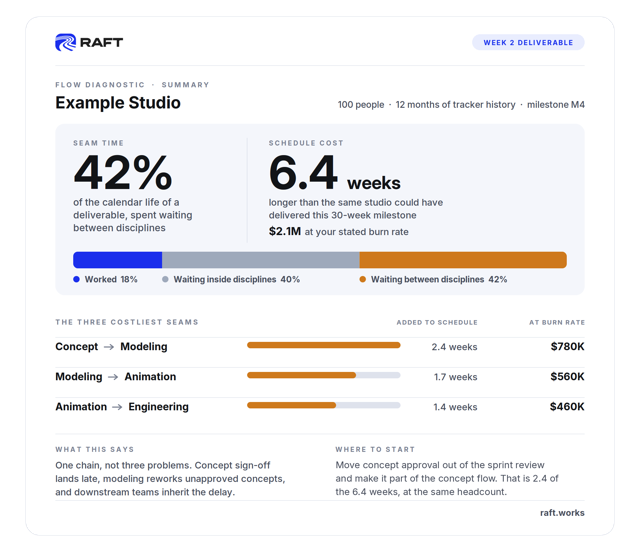
The percentage of calendar time your committed deliverables spend waiting rather than being worked
2
How many weeks your work spent waiting during your last milestone
3
That figure priced in dollars at your own burn rate.
4
The same figure at every cross-discipline handoff, so you know which seam is worst rather than which team is slowest
5
The three costliest seams, ranked, with what is actually causing each one
6
A 90-day plan you can run without me
Illustrative example of a RAFT Flow Diagnostic summary report.

What I need from you

Read-only access to your tracker (Jira, Favro, or similar). One point person. About two hours of lead time across the two weeks. No engineering time, no new tooling, no process change.

$9,500
Fixed. Two weeks.
Half on signing, half on delivery.
No methodology adoption required. No headcount recommendations. No multi-month assessment.

After the readout

You leave with the number, the three costliest seams and a 90-day plan written for your team to run without me. That is a complete engagement on its own.

If the readout names a seam your team cannot close while it is also shipping, that is what the RAFT Flow Sprint is for: four to six weeks on the worst two, scoped at the readout against the number we are both looking at.

Why me

Nine shipped AAA titles in production roles at Xbox, 2K, EA and Harmonix, including Rock Band, The Sims, Tiger Woods PGA Tour and Amped. Fifteen years scaling production tooling at Hansoft, acquired by Perforce, and at Favro.

I have trained more than a thousand practitioners in parallel flow at game studios and enterprise software companies. RAFT came out of that work. I watched a thousand teams default to sequential handoffs, and named what the good ones were doing instead: working the same deliverable at the same time.

I have lived the queue from inside production and spent a career on the tools that run it.
Jon Leslie, founder of RAFT

Reasonable questions

Ask any questions. jon@raft.works
Do we have to adopt RAFT?

No. The diagnostic reads what is already in your tools and reports what is true. If you never use RAFT, the number is still the number.

We already track cycle time. Does Jira not do this?

Some of it, yes, and I am not going to pretend otherwise. Your changelog holds every status transition, and there are marketplace apps that will compute time in status and even flow efficiency for a board. Two things are almost always true anyway. First, nobody has configured it, because ruling on which statuses count as waiting crosses every discipline boundary, and inside a studio whoever makes those rulings either lacks the authority to rule across teams or has a stake in the answer. Second, and more important, those reports are per board. They tell you how efficiently art is running. They do not tell you how long a finished asset sat before engineering picked it up. Crunch does not form inside a discipline. It forms in the seam between two of them, and that is the number this engagement produces.


Is per-team flow efficiency not the same thing?

No, and the difference is the whole reason this exists. A studio can have five disciplines each running at healthy flow efficiency and still ship late, because the handoffs between them are where the calendar goes. Measuring each team separately can make a studio look fine right up until the milestone slips.

Is this an AI tool?

Software does the measurement. The analysis and the readout are mine. I am not going to hand you a model’s opinion about your studio.

Do you need to be on site?

No. Everything runs from a read-only export and a video call, including the classification session and the readout. If you want the readout delivered in person, I will fly to you.

What does this touch?

Read-only access to your tracker. Nothing else. No build access, no repo access, no telemetry, and no changes to how your teams work.

Who is this for?

Studios of 30 to 300 running multiple disciplines against a fixed ship date. Most useful when someone senior already suspects the schedule is leaking and cannot prove where.

We came out of a restructure recently. Is it too soon?

Usually it’s the opposite. While cuts are still happening, I’d wait. Findings get read as ammunition, and nothing gets fixed. But six to twelve months out is often the best moment to do this: the seams a reorg opened up are still visible, the team can feel them daily, and leadership has the mandate to close them. If you’re not sure where you sit, the 30-minute call is the cheapest way to find out.

Have more questions?

Next step is a 30-minute call.

I will tell you on that call whether I think there is a real number to find in your studio. If I do not think there is, I will say so.
No deck and no pitch. I will tell you in thirty minutes whether there is a real number in your studio.